
Digitalization & language: How much streamlining can we afford?
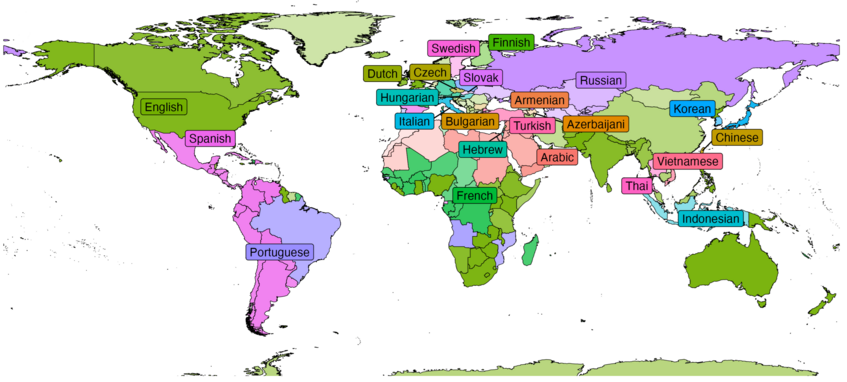
Dominant language edition of Wikipedia for each country between 2015 and 2024, according to our WikiLingDiv dataset.
Digitalization impacts which languages we choose for communicating and how we use them. There is an evident gap between distributions of languages in the digital and the non-digital sphere, referred to as the digital language divide, with language usage in digital communication and interaction being strongly biased towards only few dominant languages. At the same time, research on the impact of AI has shown that linguistic usage in interactions with large language models (LLMs) is becoming more homogeneous. Thus, we observe streamlining effects both in diversity across languages as well as within languages. But how much of this linguistic streamlining can societies actually afford? In our panel discussion, we discuss this question with experts in the field.
- Stephanie Godec (Head of Department Education, Austrian Commission for UNESCO (ÖUK))
- András Kornai (Professor of Mathematics, Budapest Institute of Technology)
- Britta Schneider (Professor of English Applied Linguistics, University of Vienna)
- Hannes Werthner (Professor of Computer Science and co-founder of the Digital Humanism initiative, TU Wien)
Programme:
- 17:00 | Doors open
- 17:15 | Welcome address and brief DIGILINGDIV research update
- 17:30 | Panel discussion
- 19:00 | Snacks & drinks and poster presentations
Essential information
- When? Monday, June 15th, 2026, 17:00-20:00
- Where? Hofburg, Batthyany-Stiege, Schreyvogelsaal (entrance in Michaelerkuppel, to the right of the Sisi-Museum)
- Languages: German and English
- How? Registration closed.
Funded by WWTF (ICT23-012)